No Products in the Cart


Last Updated: October 7, 2026
No, lice cannot survive long without a human host. Head lice feed on human blood several times a day, and once off the scalp they dehydrate quickly.
This guide from Coco Loco Natural Lice Treatment answers the question parents ask us most: if a louse falls onto a pillow, a couch, or a carpet, how long is it a threat?

Below, we cover how long lice survive off a human host, how that differs by life stage, and what matters when you check and comb your child's hair.
Head lice, body lice, and pubic lice are three separate pests with different habits, and they do not survive off a host the same way. Head lice live on the scalp.
"How long do lice live off a person" depends on which louse you mean. Body lice survive longer because they stay tucked in fabric. Head lice, the ones you deal with at school pickup, are the least suited to life away from a scalp.
Head lice are specialists. Their claws grip a hair strand, not a floor. They feed on blood from the scalp regularly to stay hydrated, so once they are off a head, the clock starts ticking.
Body lice are the exception. Because they live in clothing and bedding and only visit skin to feed, they can survive somewhat longer away from direct body contact when fabric is nearby. Pubic lice behave more like head lice, dying fairly quickly once removed.
A head louse off the human host typically dies within one to two days, often sooner. Exact survival depends on temperature, humidity, and how recently it last fed.
Here is a practical way to think about it:
| Time Off the Host | What Is Happening |
|---|---|
| First few hours | Louse is mobile but already dehydrating |
| 24 hours | Most adult lice are dead or dying |
| 48 hours | Survival is unlikely |
| Beyond 2 days | Effectively no risk |
Heat and dry air speed this up: a louse on a warm, dry surface dies faster than one in a cool, humid spot. That is why the "lice can live for weeks on furniture" claim does not match what we see in practice.
Lice move through three stages, and each behaves differently once off the scalp. Knowing the stages helps you understand what you are looking at when you comb, and answers the biggest worry parents bring us: can a nit that fell onto a couch hatch and start a new infestation?
Adult lice are the crawlers you can sometimes see moving. They are the hardiest stage, but even adults need a blood meal regularly and begin to dehydrate within hours of leaving the scalp. An adult female that has mated just one time can then lay eggs on her own, averaging around five eggs a day for roughly three weeks before she dies of old age.
Nymphs are the immature stages. After hatching, a louse goes through three molts, first stage, second stage, third stage, before becoming an adult, and that whole process takes about 7 to 10 days. Nymphs are smaller and more fragile than adults, so they survive off a host for a shorter time, and they cannot lay eggs.
Nits are the eggs, glued to a hair strand close to the scalp where warmth helps them incubate. They need that warmth, and this is where a lot of online information gets fuzzy:
One detail worth clearing up: eggs are laid close to the scalp, but older nits and empty casings can sit farther down the hair strand as the hair grows out. So finding a nit several inches from the scalp does not automatically mean an active infestation. It may just be an old, hatched casing. That is why we look for live lice and nits attached close to the scalp, not just any speck in the hair.
Parents often worry that a missed nit on a pillowcase will restart the whole cycle. In practice, the reinfestation risk comes from eggs and lice still on a head, not from eggs scattered around the house. That is the practical reason our philosophy is to focus on the head, not the house. The 7 to 10 day hatch window and the additional 7 to 10 days to molt through three stages into an egg-laying adult are the timeline that matters, and that timeline only runs on a scalp.
Head lice can end up on furniture, carpets, and bedding, but they cannot live there. A louse that falls off a head onto a couch is running out of time. The bigger question parents have is: how likely is a surface to pass lice to my child? The honest answer is that surface transmission is a minor player compared with direct head-to-head contact.
Head lice are built for a scalp. Their claws grip a hair strand, not fabric fibers. They do not jump, fly, or crawl across a room looking for a new head.
That does not mean surfaces are zero risk, a louse that just fell off a head and is still on a shared pillow could, in theory, crawl onto the next head that touches it.
You do not need to strip the house. Here is what actually helps:
NitNabber® Professional Lice & Nit Comb →
Washable bedding and towels
Nonwashable fabric items
Combs and brushes
Furniture and carpets
Hats, scarves, and hair accessories
This is where a lot of parents burn out. They bag up every stuffed animal, strip the whole house, and spend a weekend cleaning rooms that were never the problem. Head lice live on the human head, that is the environment they are built for, and where treatment and checking belong. The 7 to 10 day hatch window and the additional 7 to 10 days to molt into an egg-laying adult only run on a scalp, not on a couch cushion.
One of the biggest mistakes parents make is looking through their child's hair and assuming that if they don't see anything moving, there must not be any lice. Head lice can be surprisingly difficult to spot, especially when there are only a few.
I've been checking heads for lice since 2012, and here's what I've learned: A good lice comb is much more reliable than just looking through the hair.
Many inexpensive plastic combs included in drugstore lice treatment kits have teeth that are too far apart to effectively remove tiny lice and eggs. I recommend a professional-quality, stainless steel, micro-grooved lice comb, like our NitNabber®.
First, detangle the hair. Next, wet it with a little water and detangler or conditioner. Make a few passes with the comb around the nape of the neck, around the ears, and around the forehead.
Every few passes, wipe both sides of the comb on a slightly damp white paper towel or baby wipe. Look for any eggs or bugs. If you don't see any, you can stop. You don't need to comb through the entire head for a routine quick check.
The four-quadrant method is for a complete comb-out when treating an infestation, not a quick monthly lice check.
Dandruff and lint generally slide off a hair strand more easily than a firmly attached nit.
I recommend a quick five-minute lice check about once a month, especially during school, sports, and camp season.
Watch the 4-minute lice check demonstration on YouTube.
Key takeaway: Don't rely on a quick visual inspection. A good lice comb and a damp white paper towel help you spot signs of lice early.
Using a lice comb well comes down to sectioning, angle, and patience.
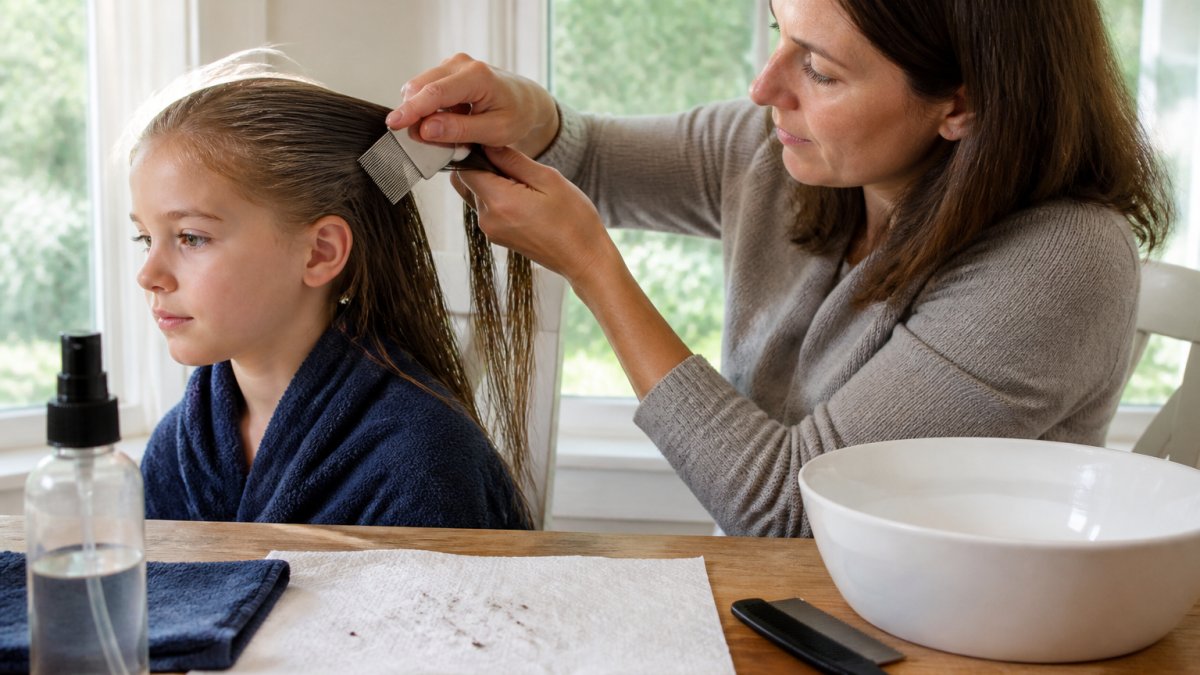
A common mistake is combing only the top layer of hair. Lice and nits sit close to the scalp, so get underneath and lift each section as you go.
This is where the right tool earns its keep. The NitNabber Professional Lice Comb from Coco Loco was developed by our founder, Pam Skinner, and uses closely spaced, micro-grooved metal teeth designed to grip lice, eggs, and nits as the comb moves through the hair.

If you are treating an active infestation and want everything in one place, the Coco Loco Nit Kit combines the 16 oz leave-in spray with the NitNabber comb and step-by-step guidance.
When you're treating an infestation, this video shows how I comb through all four quadrants using the NitNabber®.
Watch the 10-minute comb-out video on YouTube.
Lice prevention for long hair starts with how the hair is worn. Lice love loose hair because it gives them an easy path from one head to another.
A few habits that help:
Head lice spread through direct head-to-head contact far more than through shared items. They do not jump and they do not fly.
The real challenge with head lice is not your couch or your carpets.
No. Head lice live on the human head, not in your bedding. They need a blood meal from a human scalp to survive and die within a day or two off a person. For peace of mind, you can put sheets, pillowcases, and bath towels in a hot dryer for 20 to 30 minutes, then put them right back on the bed. They are sanitized. No need to wash everything daily or throw anything away.
Adult head lice typically die within one to two days off a human scalp. They need to feed on blood regularly and dehydrate quickly without access to a host. Nymphs, the younger stages, are even more fragile. Eggs, or nits, cannot hatch at room temperature off the scalp. This short survival time is why focusing on combing and checking the head matters far more than deep-cleaning your home.
Lice can fall onto pillows, blankets, or furniture, but they cannot live there. Without a human host to feed on, they die within a day or two. A sticky lint roller works well for fabric surfaces like stuffed animals and pillows for peace of mind. You do not need to spray your house or treat furniture with chemicals. Lice need the human head to survive.
After a thorough comb-out with a professional lice comb, the risk of spreading lice drops significantly. However, because eggs can hatch over a 7 to 10 day window, it is wise to do a follow-up check several days later. You do not need to check every day. Combing the hair, checking weekly, and using a leave-in treatment like Coco Loco can help you stay ahead of any remaining lice.
